Princess Hairstyles Coloring Pages
👑 Free Printable Princess Hairstyles Coloring Pages
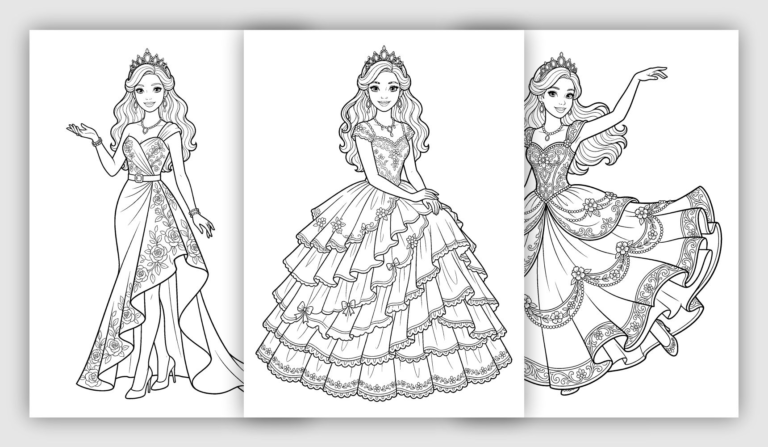
These free printable princess hairstyles coloring pages feature royal portraits where the hair is the main focus. Each design is available as an individual A4 PDF. The princesses wear crowns and tiaras, but instead of showing full-length gowns or castle scenes, the illustrations highlight different hair lengths, textures, and arrangements. You'll find long flowing waves, tightly curled ringlets, elegant braided updos, neat bobs, and short pixie cuts. Some portraits have plain backgrounds that keep attention on the hairstyle, while others are framed by detailed flowers and decorative foliage.
The collection includes princesses with side braids, twin plaits, braided crowns, smooth straight hair, and carefully gathered buns. Several portraits feature contemporary hairstyles, including chin-length cuts with bangs and short wavy bobs paired with glasses. The more elaborate pictures combine royal hairstyles with roses, lilies, irises, and flowering branches. These princess hair coloring sheets offer a closer look at the individual strands, overlapping braids, soft curls, and decorative crowns that distinguish each hairstyle.


🎨 Coloring Princess Hair, Braids, and Crowns
Hair texture can influence how you apply color. Smooth, straight hairstyles work well with longer pencil strokes following the direction of the strands. For wavy hair, curved strokes can emphasize the movement of each section, while tighter curls benefit from small changes in shade between overlapping ringlets. Braids have a repeating woven structure, so try using a lighter base color and adding a darker tone where the strands cross. Blonde, chestnut, auburn, and black are natural choices, but the same techniques work with fantasy shades such as lavender, rose pink, or silver-blue.
The crown and surrounding decorations can complement or contrast with the hair. Gold and silver are traditional choices for tiaras, while gemstones can be colored ruby red, emerald green, or sapphire blue. In portraits surrounded by flowers, a limited palette can keep the hairstyle prominent. For example, warm-colored roses can contrast with dark hair, while pale flowers can frame brightly colored curls. These combinations are suggestions rather than rules, and you can experiment with any hair colors or decorative details you prefer. Click on any image to enlarge and explore the details up close.


Example Coloring Detailed Hairstyle
This example applies the same blending approach with more attention to tone variation. Slight shifts in color help separate strands and suggest depth within the hairstyle. By blending along the curves of the hair, the hairstyle feels fuller and more structured, while still remaining calm and decorative rather than highly detailed.
💇♀️ Exploring Hair Shapes and Details in Princess Portraits
Because the princesses are shown mainly from the shoulders upward, the illustrations make differences in hairstyle shape easy to notice. A rounded bob follows the jawline, while a pixie cut stays close to the head and uses shorter, overlapping sections. Long straight hair creates a smooth outline around the shoulders, whereas wavy and curly hairstyles have fuller silhouettes. These distinctions are useful when deciding how to color a portrait: the direction of the lines often suggests where highlights and darker sections will look most natural.
Braids introduce a different kind of detail from loose hair. In the side-braid portraits, thick sections cross repeatedly before continuing down one shoulder. Twin braids form a more balanced arrangement on either side of the face. Other hairstyles incorporate braids around the crown of the head or gather them into an updo. The individual sections can be colored with related shades to preserve the woven appearance. Keeping the transitions subtle is often more effective than making every overlapping strand a completely different color.
The shorter hairstyles give several portraits a more contemporary appearance. Some princesses have smooth bobs with side parts, others wear straight bangs, and one has a closely cropped pixie cut. Glasses appear in several of these illustrations, adding another recognizable detail beneath the traditional royal crowns. These portraits have relatively uncluttered backgrounds, which makes the shape of the hair especially noticeable. They also provide an opportunity to try different combinations of hair color, eyewear, and crown decorations without needing to color an elaborate landscape.
The floral portraits offer a more intricate alternative. Large roses surround some princesses with flowing waves or elaborate updos, while lilies, irises, and flowering branches frame other hairstyles. The flowers occupy the background and edges of the compositions, but their petals and leaves create additional shapes that can be colored independently. Choosing related shades for the flowers can help them form a consistent frame around the portrait. The drawings with dense curls, braids, and botanical details are well suited to anyone who enjoys careful coloring, while the simpler portraits offer larger, more clearly separated areas.
Each princess portrait is available as an individual printable A4 PDF, allowing you to choose a particular haircut, braid, or hairstyle to color. Print at 100% scale to preserve the original proportions and fine outlines, especially around overlapping strands, small curls, crown details, and flower petals. Colored pencils are particularly useful for following the direction of the hair and creating gradual changes in tone. Fine-tip markers can be used for more defined color sections, while a lighter pencil touch makes it easier to preserve highlights.