Whimsical House Coloring Pages for Adults
🏡 Free Printable Whimsical House Coloring Pages for Adults
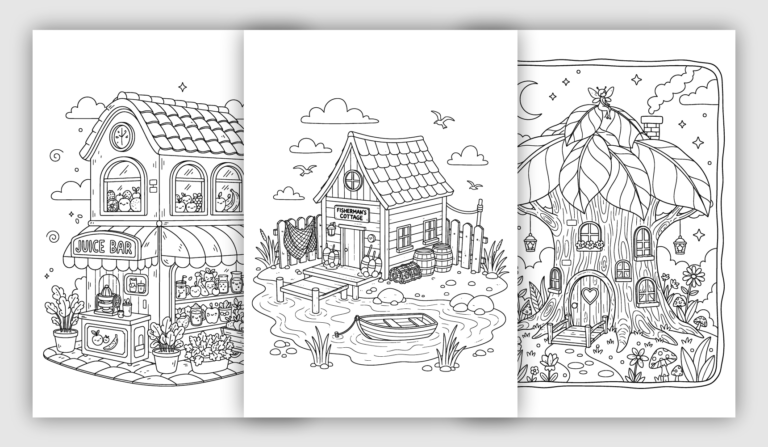
These free printable whimsical house coloring pages for adults feature detailed fairy-tale cottages, imaginative tree houses, unusual woodland homes, and fantasy architecture. Each illustration is available as an individual A4 PDF. The houses are built from unexpected shapes and materials, including giant mushrooms, seashells, flowers, tree trunks, and everyday objects. Others resemble traditional cottages and village shops, but with crooked roofs, ornate windows, and playful architectural details. The drawings combine recognizable buildings with imaginary settings, offering intricate designs for adults who enjoy coloring houses, cottages, and miniature fantasy worlds.
The fairy house designs include acorn cottages, mushroom villages, homes hidden beneath enormous tree roots, and tiny dwellings suspended from branches. Some tree houses have ladders and balconies, while others become elaborate woodland castles. Beyond the forest, a cottage floats on a cloud beneath a rooftop telescope, another travels beneath a hot-air balloon, and underwater houses take the shapes of shells, coral formations, and sea creatures. The collection also features detailed village storefronts, from bakeries and bookstores to cafés and specialty shops. Roof tiles, stone paths, wooden beams, decorative signs, and surrounding plants give the illustrations their distinctive character.


🎨 Color Ideas for Whimsical Houses and Fairy Cottages
The materials and surroundings of each house can suggest a color palette. Woodland cottages work well with bark browns, mossy greens, warm stone grays, and muted terracotta. For a house built into a tree, changing the pressure of a colored pencil can distinguish rough bark from smoother wooden doors and window frames. Mushroom cottages allow more unusual combinations, such as a red or golden cap above cream-colored walls, or soft violet and blue for an enchanted forest appearance. When a drawing contains intricate architectural textures, a few related shades can create depth without making every roof tile or stone a separate color.
Other settings invite different choices. An underwater shell house could combine turquoise, coral pink, lavender, and pale sand tones, while a snowy cottage might use cool blue shadows against warm colors around its windows. Village shops can have painted doors, colorful awnings, and contrasting window frames. Small accents on flower boxes, lanterns, signs, and balconies help distinguish one building from another. These combinations are suggestions rather than rules, and you can choose entirely different colors for your imaginary houses. Click on any image to enlarge and explore the details up close.


More Whimsical Houses to Color
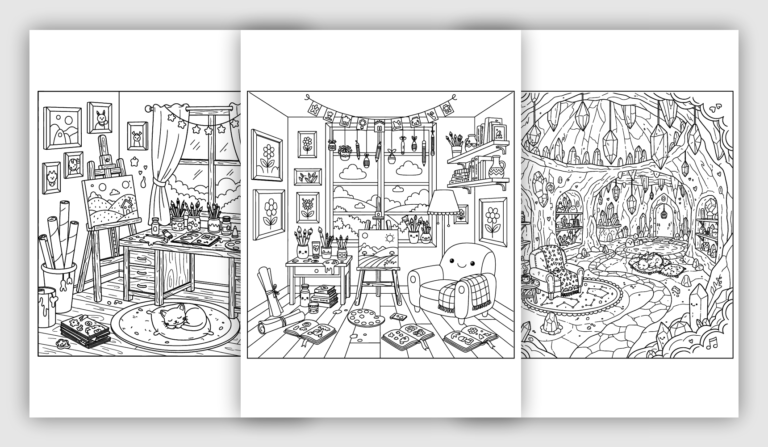
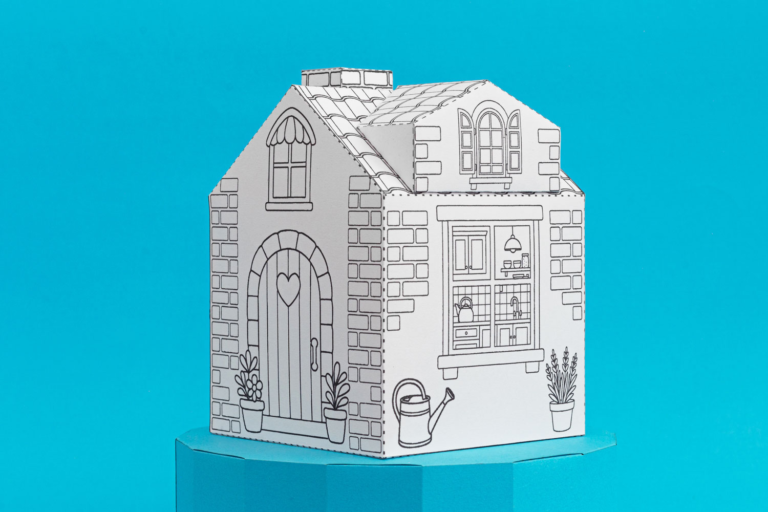
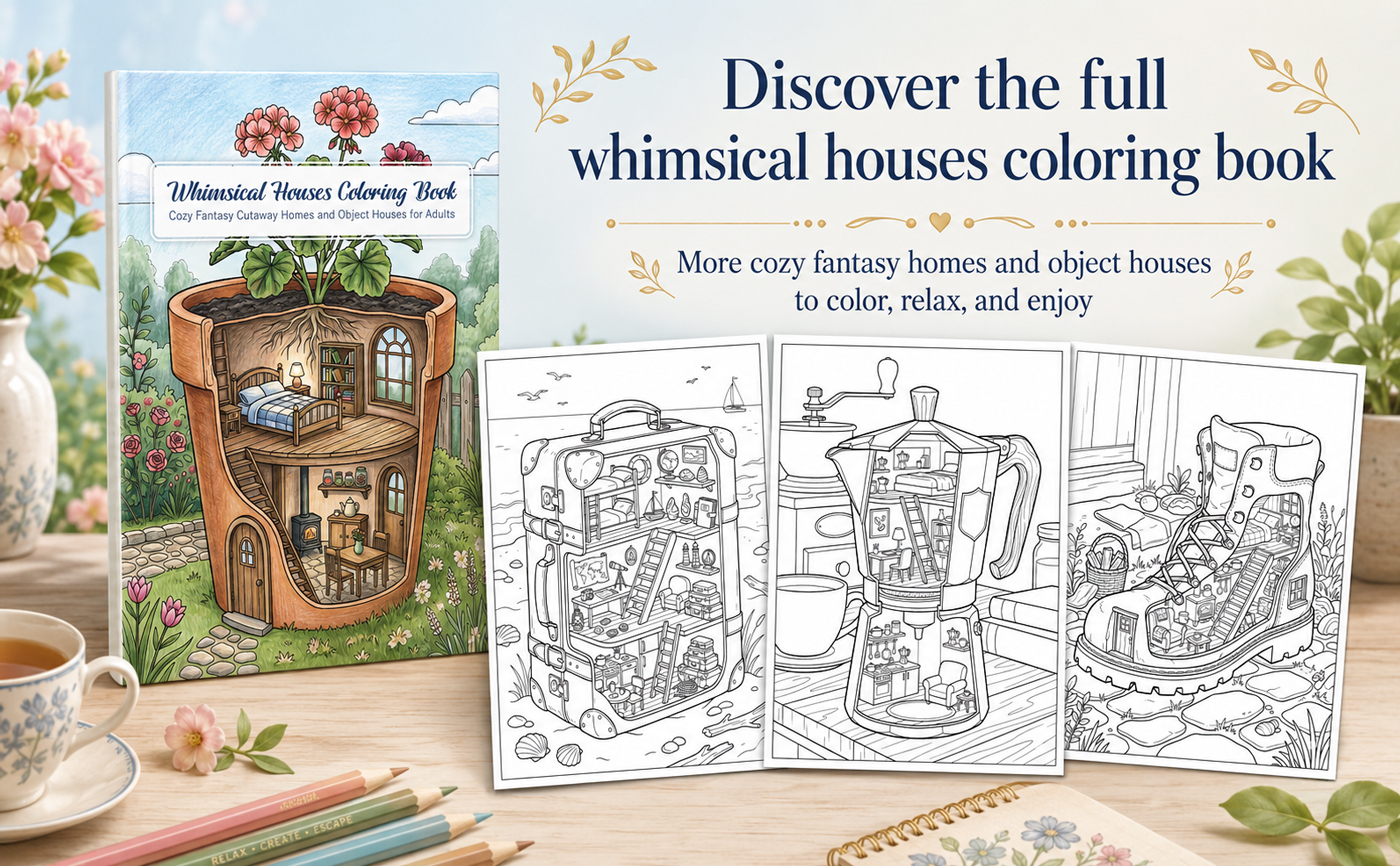
If you enjoyed these house coloring pages, I also created a full paperback coloring book with 50 detailed whimsical house illustrations. These are not ordinary houses — each one opens up to reveal a tiny inner world, with cozy rooms, hidden corners, and imaginative little details to discover as you color.
Inside the book, you’ll find fantasy homes, cutaway houses, and object houses where everyday things become charming places to live. Every illustration is designed as a small story, with furniture, stairs, windows, plants, and carefully drawn interiors that make the page feel alive.
The button below will take you to Amazon, where you can see more details about the book and decide if you would like to add it to your coloring collection.


🎨 Visual Masterclass: The Mushroom House Step-by-Step
To help you get started, we’ve prepared a detailed demonstration using one of our favorite illustrations from this collection. Seeing the mushroom house coloring process step-by-step makes it much easier to understand how to layer colors and where to place your strongest shadows for maximum impact.
This visual guide follows the Three-Tone Method we discussed above. By observing how the house evolves from a flat line drawing to a vivid, atmospheric piece, you’ll gain the confidence to experiment with your own palettes. Pay close attention to how the highlights on the mushroom caps remain bright to simulate natural light.

Step 1: Light Tone (Base and Highlights)
This example demonstrates the first layer, where the lightest shades establish the foundation of the illustration. Pale Pink, Golden Ochre, and Spring Green are applied with very light pressure using soft circular motions. All areas are covered evenly, while tiny white spots are intentionally left on raised surfaces, such as the mushroom cap curves and fern tips, to suggest natural shine and morning dew.

Step 2: Medium Tone (True Color and Volume)
In this stage, the medium tones define the real color and begin shaping volume. Carmine Red, Burnt Sienna, and Grass Green are added mainly to side surfaces and lower areas, assuming light falls from above. The center of each element remains lighter, allowing the base layer to show through. This creates a soft, organic transition and makes textures like moss and wood feel alive.

Steps 3–4: Dark Tone and Soft Transitions (Depth and Integration)
This final example combines shadow placement and color blending. Deep Burgundy, Dark Umber, and Forest Green are applied sparingly in the deepest recesses: under mushroom caps, inside bark cracks, beneath steps, and where plants touch the ground. To finish, the lightest pencils are gently layered back over transitions, blending all tones together. This softens edges, unifies surfaces, and gives the house a clear sense of depth without harsh contrast.


🏘️ How Ordinary Architecture Becomes a Fairy-Tale House
One of the most interesting features of these drawings is how familiar architectural elements adapt to unusual shapes. A mushroom cap becomes a roof, the hollow center of a tree becomes an entrance, and a large seashell provides a curved exterior wall. Small windows, chimneys, steps, and balconies make these structures recognizable as homes. The proportions are deliberately imaginative: a door may be tucked beneath an enormous flower, while a chimney rises from the top of a giant boot. These details are worth noticing because they show how a fantastical building can still follow the basic visual language of a real house.
The woodland scenes offer different interpretations of fairy houses and tree houses. Some buildings rest against large trunks with roots extending around their foundations. Others sit high among branches, connected to the ground by stairs or ladders. The Acorn Castle is especially elaborate, with rooms, balconies, and walkways arranged across a giant tree. By contrast, the small acorn and mushroom cottages keep their main architectural features close to the ground. The surrounding leaves, bark, stones, and plants are part of the structure's appearance rather than simply a decorative background. Their irregular outlines contrast with the straighter lines of windows, stairs, and wooden railings.
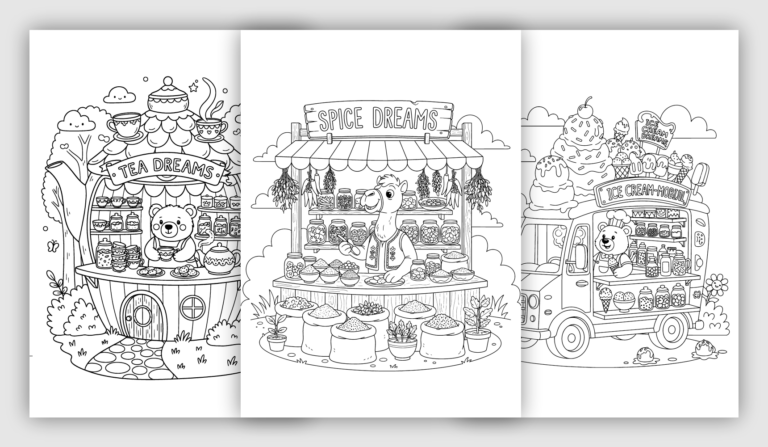
The village buildings introduce a different kind of detail. A bookstore is recognizable through shelves visible in its windows, while the bakery and chocolate shop have displays connected to the products they sell. Striped awnings, ornamental signs, flower boxes, bicycles, and outdoor tables help distinguish the storefronts. These architectural coloring pictures can be approached differently from the woodland cottages. Coordinating the colors of a façade, roof, doors, and awning gives each shop a recognizable identity, while the smaller window displays provide places for brighter accents. The combination of traditional building shapes and carefully drawn commercial details gives these scenes a miniature village appearance.
Several houses challenge the idea that a building needs to stand on solid ground. One rests on a swirling cloud, another hangs beneath a patterned balloon, and others occupy imaginary underwater environments. The ocean dwellings incorporate shells, coral, starfish, and jellyfish shapes into their architecture. These drawings also contain different kinds of fine detail: curved shell ridges, branching coral, tiny windows, and clusters of sea plants. Unlike the repeated lines of roof shingles or brickwork, these natural forms have irregular patterns. Following their curves with colored pencils can help separate the building from its surroundings while preserving the unusual shape that makes it recognizable.
Each design is available as an individual printable A4 PDF. The collection includes both relatively open compositions and intricate house coloring pages with closely spaced architectural details, making it possible to choose a drawing according to your preferred level of complexity. Print at 100% scale to preserve the original proportions and fine outlines, especially around small windows, shingles, wooden textures, and decorative borders. Colored pencils are useful for narrow spaces and subtle variations in building materials. For densely illustrated cottages, working on one architectural section at a time can make it easier to keep the different textures and details distinct.